 | ||
What a return this is of the much-adored deity – this time in present age, where Lord Bramha keeps a tab on Earth's soaring crime graph over the computer and Narad strums a guitar instead of the sitar.
A worried Lord Hanuman is moved by the plight of Minku who is bullied by his classmates and wants to go to Earth to help him. Hanuman checks on the boy through a computer screen and zooms in to Bajrangpur, to keep a track on the boy very often. He also tells Narad that seeing the same faces up in the sky, main pak chuka hoon. When not following Minku's life, Hanuman, mischievous to the hilt, zips around the world replacing himself with the Statue of Liberty and throwing Osama Bin Laden and George Bush in a net.
When Hanuman approaches Lord Bramha for permission to visit Earth, Bramha tries to dissuade him and asks Chitragupt, who is busy surfing meneka.com, to show Earth's escalating crime rate. But Hanuman is adamant and Bramha finally agrees after he signs a `contract' and agrees to all the conditions. Thus a baby with a tiny tail is born to a Pundit. Maruti, as he is named, is an adorable child who grows inexplicably fast and is forever hungry. He becomes the savior of Minku and his other harassed friends (a nerdy girl, fat boy, clichés galore).
Meanwhile demons, like Rahu and Ketu, who had vanished from Earth to live in Shukragraha, are back. A series of events sets off the `parlay', where humankind is on the brink of being destroyed by nature's fury. There's a neat message towards the end, though not fully explored, of stopping the exploitation of Mother Nature.
The filmmaker (Anurag Kashyap) is convinced that details on the story are not that important, and that kids are not going to want to know the layers of why and what, as long as Hanuman whacks the bad guys cold. Which is why the explanation of the story's context is hurried through in the beginning, making the viewer feel a tad rushed. Perhaps the story could have been thrashed out more peacefully with explanations that kids would follow.
Kids are likely to enjoy the modernisation of the tale, right from the colloquial Hindi-English interspersed conversation, to the use of computers and fax machines etc. There are plenty of innovative modern touches that are likely to tickle the little viewers, like when Lord Vishnu is fighting a demon that breathes fire, Vishnu uses a fire extinguisher to douse the flames. Takeoffs are replete with spoofs on Matrix, Sholay's Gabbar Singh and even Himesh Reshammiya; some work, some don't. Dialogues by Anurag Kashyap does a great job of balancing contemporary with mythical with a generous sprinkling of wit. Narad, in an interesting spin on the popular phrase of walls having ears, sushes Hanuman saying, Yahan badalon ke bhi kaan hote hain.
What is disappointing is the chauvinistic portrayal of women characters – they're either sari-clad mothers or cheerleaders in short red skirts and apsaras in revealing clothes. One might be tempted to skim over this in the name of light-hearted fun, but kids are perceptive and pick up fast, and such stereotypical images just strengthen the already biased conditioning society feeds them. While there's no control over the content in films otherwise, a children's film perhaps ought to be more accountable.
The songs are fabulous (music by Tapas Relia; lyrics by Satish Mutatkar). Animation, as in the earlier Hanuman, is superlative. While Return of Hanuman is not a sequel to Hanuman, comparisons are inevitable. While Hanuman had more to tell in terms of story, Return of Hanuman excels in the storytelling style serving up a modern-mythological combination. It's aloo paratha with pizza topping-your kids will love it!


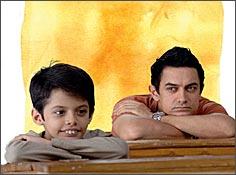 It is hard to know, as a director, when there can be too much of a good thing. Khan indulges himself with his nice little visual flourishes significantly in the first half, to the point of repetition. There is the clever device of the child -- being shunted off to boarding school against his desperate pleas -- making a flipbook which shows a family with one kid moving away, as the pages turn. It's a strong, simple touch, yet Khan chooses to show it to us again and again, showing the audience the flipbook every time any character sees it.
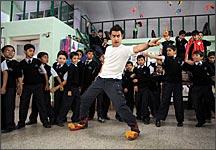 Yet, let's discount that as nitpicking. This is the story of the child and his teacher, and Nikumbh stands at a blackboard and shows pictures of Albert Einstein and Abhishek Bachchan and tells us -- and the kids -- that dyslexia is more common than we think, and that it can be helped given the proper aid. Nikumbh speaks to the faculties, asks that Ishaan be given a little more time, and, after having educating the audience thoroughly on dyslexia, proceeds to charm Ishaan out of it.


 While Strangers On A Train has one of the two strange-partners going back on the deal, Aanand Rai's Strangers does indeed proceed with what's been agreed, only changing the killer & the killed. This minor change is brilliantly captured in the last 30 minutes of the film's second half, all the while setting up this major triumph.
 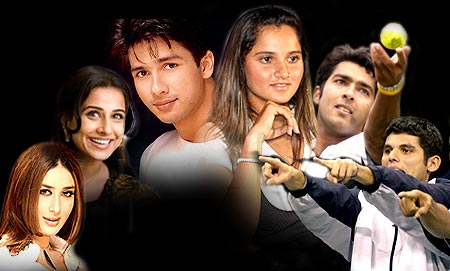 Shahid Kapoor, it seems, has gotten over Kareena Kapoor.


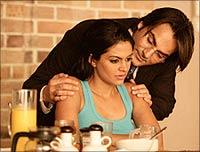 Settling in to watch Dus Kahaniyaan, one cannot help but worry about how a collection of ten short films is going to play out. Especially since Paris, je t'aime, a concept love note to the city of amour that came off as the worst kind of gesture towards a great city -- a bad one.
 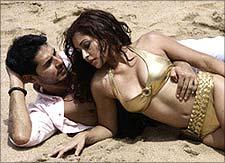 Sex on the Beach, starring Dino Morea and newcomer Tareena Patel, adds lust to the supernatural and works as a counterpoint in some ways to the film before it. There is a genuine scary moment in this film, helped by sound effects and the rather convincing menace in the leading lady's manner, and a nice epilogue in the form of a tongue-in-cheek appearance by the segment's director Apoorva Lakhia. Neither great nor totally bad, this short comes loaded with cheesecake for male and female viewers.

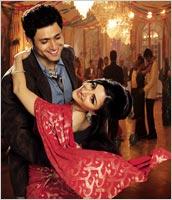 It is a fine tale of compulsions and choices, of free will and helplessness, of Filmfare Awards and fat financiers. This is one of the filmmaker's most simplistic films, however, where the characters are clearly-delineated but utterly lack subtext. It is a neat love story, conflicted yet obvious, dramatic and basic -- not that there's anything wrong with that.
 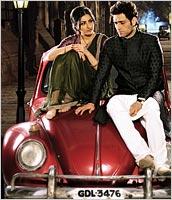 It is a tastily put together film -- much credit to cinematographer Sachin K Krishn -- but is bogged down by a self-pitying protagonist. While I could still be persuaded to not wince through the shot of the director weeping and forgetting to say 'Cut!,' Ahuja's writer-director seems too pouty and kerchief-needy -- even as everything falls into his lap. Um, more or less.
 Javed Akhtar
 Akshay Kumar has reached a stage where currently Shah Rukh Khan is. No matter who is his leading lady, no matter which production house he works with, no matter what the film's genre is, no matter who directs the film and no matter who composes for his films - the fact remains that he is audience's darling and would hit gold in each of his films. His great run in last few years is a testimony to that!
 Mona Singh, who had captured the imagination of the tele viewers with her much talked about role of Jassi in Jassi Jaise Koi Nahi will make her Bollywood debut next year.